
Software, AI, and Customer Data: What Businesses Should Sort Out Before Launch
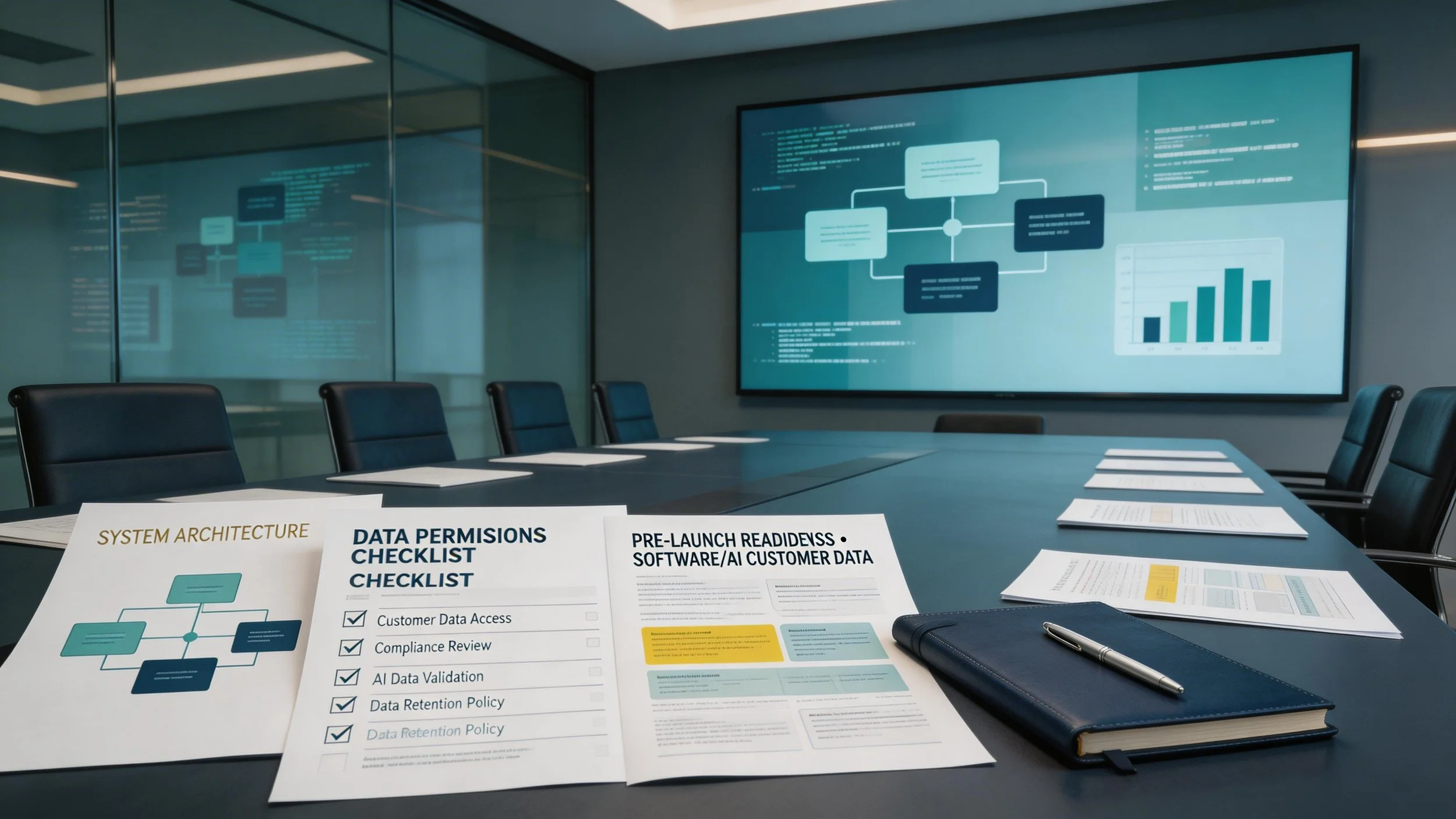
Businesses building software products, AI-enabled tools, or customer-facing data systems often ask the same broad question: “Can we protect this?” The more useful question is usually narrower: “Which parts can be protected, by which tools, and under what discipline?” Software and data-heavy businesses often assume there will be one clean answer. Usually there is not.
Different parts of the same product may point to different forms of protection. Source code and other original expression may support copyright protection.[1] Certain technical solutions may raise patent questions, subject to the familiar requirements of patentability and, in software or AI-adjacent fields, subject-matter eligibility analysis.[2] Valuable internal know-how, models, architecture, pricing logic, customer segmentation methods, and deployment processes may be better protected as trade secrets if the business is actually treating them as secret.[3] Brand names, product names, and designations associated with the platform may call for trademark work. Contracts often do the rest of the practical labor by allocating ownership, restricting use, and requiring confidentiality.
That mixed framework becomes especially important with CRM systems, analytics layers, and AI-adjacent product features. A business may have code it wrote itself, third-party tools it licensed, customer data it is permitted to process only under contract, prompts or workflows created internally, and output that may or may not be fully protectable depending on how it was generated and curated. Treating all of that as one undifferentiated “software asset” is one of the quickest ways to create ownership confusion.
A good starting point is to separate the asset types. The software code is not the same as the underlying business method. A dashboard interface is not the same as the data inside it. A model prompt library is not the same as the resulting output. A customer list is not the same as the internal scoring logic used to act on that list. Once those distinctions are visible, the protection strategy becomes clearer.
Copyright is often the easiest piece to understand. Copyright can protect original works of authorship fixed in a tangible medium, which can include software code and other original expression.[4] But copyright does not give ownership over an abstract idea, a business concept, or every functional aspect of a software product. That is one reason software businesses should be careful not to assume that having code automatically answers the competitive-protection question.
Trade secret protection often matters just as much, and sometimes more. Under the Defend Trade Secrets Act, information qualifies only if it derives value from not being generally known or readily ascertainable, and if reasonable measures are used to keep it secret.[5] In practice, that means a business needs more than the belief that something is proprietary. It needs disciplined handling: access controls, contractor and employee agreements, practical segmentation of sensitive information, and internal clarity about what is actually confidential.
A recent Federal Circuit decision is a useful reminder on that point. In Applied Predictive Technologies v. MarketDial, a software and analytics company alleged that various categories of information tied to its platform and deployment materials were trade secrets. The Federal Circuit, in a nonprecedential January 2026 decision, affirmed summary judgment against the plaintiff, emphasizing that the alleged trade secrets had not been identified and defined well enough, and that the plaintiff had not shown the required economic value from secrecy with sufficient evidentiary clarity.[6] Even though the case is nonprecedential, the practical lesson is highly relevant: if a company wants to protect software-related know-how as a trade secret, it needs to know what the secret is, how it is bounded, and why its secrecy matters.
AI adds another layer. The Copyright Office's January 2025 report on copyrightability reaffirmed that copyright protects human authorship, and that purely AI-generated output will not be treated the same as original human-authored expression.[7] The USPTO has likewise emphasized that no separate inventorship rule applies to AI-assisted inventions; the question remains whether one or more human beings made the significant contribution required under the existing legal standard.[8] And for patent eligibility, the USPTO's 2024 AI-related subject-matter-eligibility update reinforces that software and AI claims still need to be framed as more than abstract ideas, with attention to the practical application analysis under current Section 101 doctrine.[9]
For businesses, those legal points translate into operational questions. Who wrote the code? Who trained or configured the system? What third-party terms govern the tools being used? What data rights do customer contracts actually grant? Are prompts, evaluation criteria, and internal taxonomies being preserved as proprietary internal materials? Is the company documenting human contributions where that may matter later? Those questions are more useful at launch than a general statement that the company is “using AI.”
This is also why agreements matter early. Founder documents, contractor terms, developer agreements, SaaS contracts, data processing terms, and customer-facing terms of use are not just back-office paperwork. They are often the instruments that determine whether the business actually owns what it thinks it owns, whether it has permission to use the data it is using, and whether confidential internal materials have been handled consistently enough to support later protection arguments.
Before launch, the best practical move is usually an IP map. Identify the code, the brand, the data relationships, the confidential methods, the open-source dependencies, the outside vendors, the employment and contractor chain, and any feature that might raise a patent question. Then sort those assets into the right buckets. That exercise is less glamorous than saying “we have proprietary AI,” but it is far more useful when the product meets the market.
The point is not that every software business needs patents, or that every analytics workflow should be wrapped in trade secret language. The point is that software, AI, and customer-data businesses usually need a more deliberate mix of copyright, trade secret, trademark, contract, and sometimes patent strategy than they expect. The sooner that sorting work begins, the better the chances that the company launches with protection that matches the product it is actually building.
Sources
[1] 17 U.S.C. §§ 102-103, https://www.copyright.gov/title17/ ; U.S. Copyright Office, Copyright Basics, https://www.copyright.gov/circs/circ01.pdf
[2] 35 U.S.C. § 101, https://www.law.cornell.edu/uscode/text/35/101 ; USPTO, Subject matter eligibility, including 2024 AI guidance update, https://www.uspto.gov/patents/laws/examination-policy/subject-matter-eligibility and https://www.uspto.gov/about-us/news-updates/uspto-issues-ai-subject-matter-eligibility-guidance
[3] 18 U.S.C. § 1839(3), https://uscode.house.gov/view.xhtml?edition=1999#=0&req;=granuleid%3AUSC-1999-title18-section1839
[4] 17 U.S.C. § 102, https://www.law.cornell.edu/uscode/text/17/102
[5] 18 U.S.C. § 1839(3), https://uscode.house.gov/view.xhtml?edition=1999#=0&req;=granuleid%3AUSC-1999-title18-section1839
[6] Applied Predictive Technologies, Inc. v. MarketDial, Inc., No. 24-1751 (Fed. Cir. Jan. 28, 2026) (nonprecedential), https://www.cafc.uscourts.gov/opinions-orders/24-1751.OPINION.1-28-2026_2639420.pdf
[7] U.S. Copyright Office, Copyright and Artificial Intelligence, Part 2: Copyrightability (Jan. 2025), https://www.copyright.gov/ai/Copyright-and-Artificial-Intelligence-Part-2-Copyrightability-Report.pdf
[8] USPTO, Revised inventorship guidance for AI-assisted inventions (Nov. 26, 2025), https://www.uspto.gov/subscription-center/2025/revised-inventorship-guidance-ai-assisted-inventions ; see also USPTO inventorship guidance materials, https://www.uspto.gov/subscription-center/2024/uspto-issues-inventorship-guidance-and-examples-ai-assisted-inventions
[9] USPTO, AI subject matter eligibility guidance and examples, https://www.uspto.gov/about-us/news-updates/uspto-issues-ai-subject-matter-eligibility-guidance and https://www.uspto.gov/sites/default/files/documents/2024-AI-SMEUpdateExamples47-49.pdf